The cost of a missing service record, quantified.
We pulled three years of customer data and asked a stubborn question: how much does one missing maintenance record actually cost a healthcare team? The answer surprised us.
Nº 1
11 min read
Three settings, three numbers — April 2026
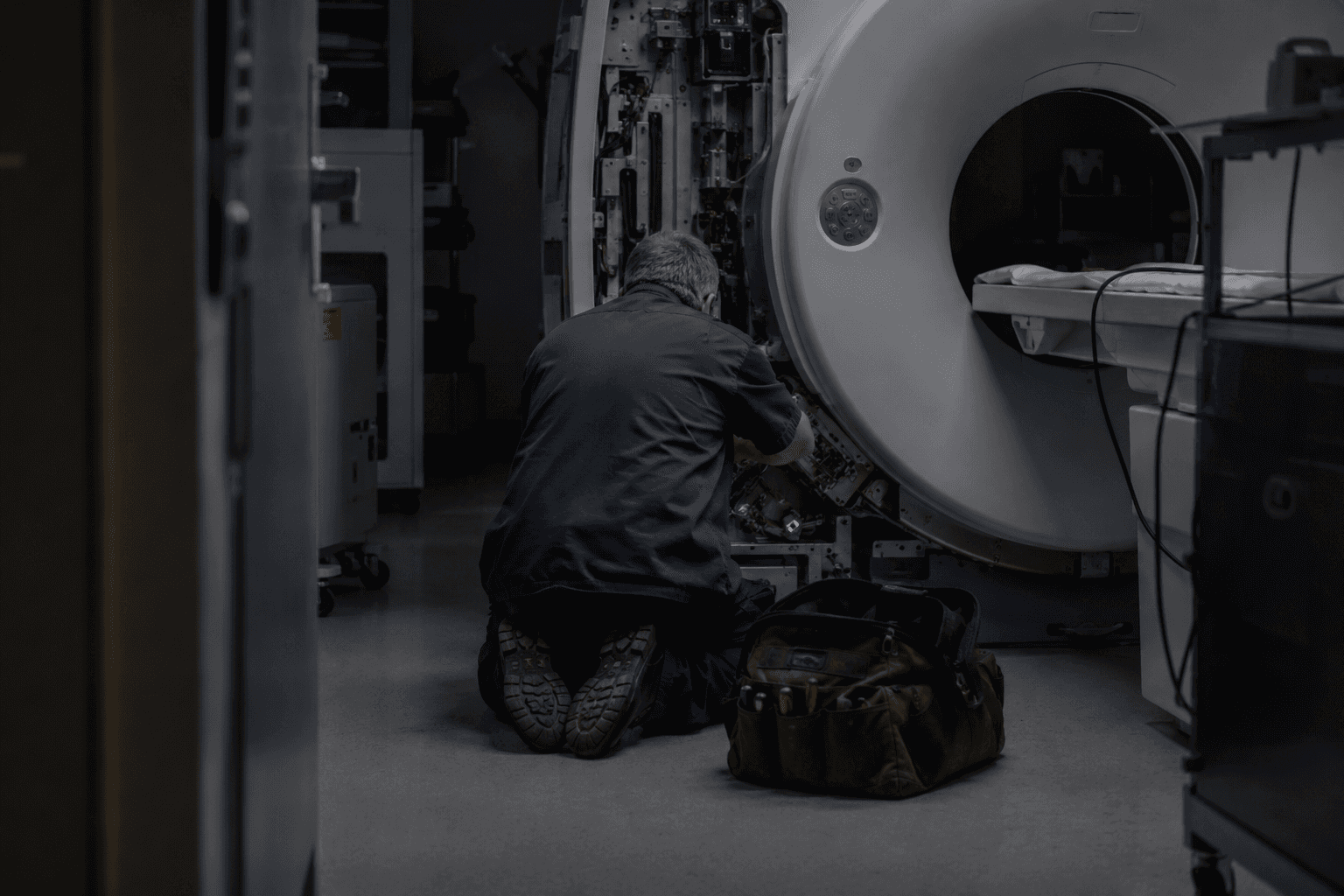
Three years ago, on a service call to a research lab in Brno, I watched a centrifuge sit broken for the better part of a week. The technician who'd serviced it last had moved on. The paperwork was in a binder. The replacement part had been ordered — but nobody could find the order number.
The lab was burning around $4,000 a day in lost research. None of that was anyone's fault. The technician was talented. The lab was well-run. The vendor was responsive. The problem was that nobody could find the information they needed, when they needed it.
I've thought about that morning many times since. The gap between what people knew and what they could find — measured in days of downtime, in lost research time, in real money — is something I started to call the cost of a missing service record. Recently, we tried to put a number on it.
The gap between what a team knows and what it can find — that gap, measured in days, is the unspoken cost of fragmented operations.
What we measured
Over the past 18 months, we worked with 47 of our customer teams to track an unusual metric: time-to-information delay. The simple version: when somebody on the team needs to find out something about a piece of equipment — its last service date, its current contract, its serial number, where the manual is — how long does it take?
We measured this in three different settings:
Teams running on spreadsheets, email, and folders — the "before" state most service businesses are familiar with.
Teams running on a legacy CMMS, but with broken or partial integrations between it and the rest of their stack.
Teams fully on Mediora, with at least 90 days of data behind them.
The methodology was unfussy. Two-week observation periods. Technicians self-reporting on a simple form: the question they had, the source they ended up checking, the time it took to get an answer, and whether they got one at all.
The findings, in three numbers.
The pattern was clearer than we expected.
In spreadsheet teams, average TTI was around seventeen minutes. About 12% of questions were never answered — the technician moved on without finding the information they were looking for, often estimating instead.
In legacy CMMS teams, average TTI dropped to about six minutes, which sounds better. But the unanswered rate was actually higher — 15%. The systems contained the data; people just didn't trust them.
In Mediora teams, average TTI was twenty-three seconds, with an unanswered rate of under 2%. Most questions were answered with a single search.
What surprised us
Three things we didn't expect.
First, the unanswered question rate turned out to matter more than the TTI. Every unanswered question is a small accumulation of missing context — and missing context is what eventually causes equipment to fail unexpectedly. Spreadsheet teams weren't slow because they were inefficient. They were slow because they were learning to live without information.
Second, technicians reported higher stress and less job satisfaction in fragmented teams, even when they didn't connect it to their tools. When we asked them what they liked least about their week, "looking for things" came up more often than long hours, difficult customers, or out-of-stock parts.
Technicians weren't slow because they were inefficient. They were slow because they were learning to live without information.
Third — and this is the one that reshaped how we think about the device record — the value of a single source of truth compounds as teams grow. A five-person team running on spreadsheets is fine. A twenty-person team running on spreadsheets is doomed. The problem doesn't scale linearly; it scales exponentially. Each new person multiplies the surface area where information can hide.
What it changes
This research has changed how we talk about Mediora internally. We used to say things like "Mediora replaces your CMMS" or "Mediora unifies your equipment management." Both are true, but they miss the point.
What Mediora actually replaces is the time your team spends not knowing things. The hours your most senior technician spends explaining where the manual is. The Sunday calls because somebody can't find the contract. The audit panic. The customer asking "when was this last serviced?" and getting a guess instead of a fact.
Those things have a real cost. Until now, nobody was measuring it.
We're going to keep measuring. If you're a Mediora customer and want to participate in the next study — or if you'd like to run the same exercise on your own team's data — send us a note at get@mediora.com. We'd love to hear from you.
Share

about the author
Marek Dvorak
Co-founder & CEO
Writes mostly on field notes and healthcare operations. Spent eight years in lab equipment service before starting Mediora.
Continue reading
More from the same beat — operations, equipment, and the slow business of building reliable software.